Steel detailing is an essential part of the construction process and is integral to successfully completing any steel-based building or structure. It was born out of a necessity for trying to eliminate the risk of having somebody do the math wrong.
A steel detailer is a professional who creates detailed drawings and models of steel structures and components, which steel fabricators use to construct the final product. Without accurate and precise steel detailing, a construction project can be plagued with errors and delays, which can be costly and potentially dangerous.

Is the Steel Detailer an Engineer or an Architect?
It doesn’t have to be. I will quote the conversation from the Construction Brothers Podcast.
A: Describe it. What do you do?
Construction Brothers Podcast
B: I am a structural steel detailer.
A: What is that?
B: All the steel that’s in buildings. I draft it.
A: But doesn’t the structural engineer do that? So you are like an architect?
B: No, I am not an architect.
A: Then you are like an engineer?
B: No, I am not an engineer.
A: Well, How do you do steel buildings if you are not an engineer?
B: Because the engineer tells me what to do.
A: Why do they need you? They already know what to do. Why are you there?
B: Because without me, they will be lost.
A: How?
B: Because They wouldn’t know how to actually put the building together.
Detailers are paid to listen and follow directions. First, the structural engineer does the documentation, and then a steel fabricator is awarded a contract by the general contractor. After that, the fabricator either has an in-house or third-party steel detailer that works as a subcontractor. The job of the steel detailer is to convert the structural documents into a complete workshop package, like GA drawings, assembly, single-part drawings, NC data, and lists.
The Steel Detailing Process
Steel detailers use specialized software to create detailed models of steel structures, which can then be used to generate fabrication drawings and bills of materials. Therefore, they must be highly skilled in computer-aided design (CAD) software and have a strong understanding of engineering principles, construction methods, and building codes.

Nowadays, most steel detailers work in 3D drafting software, for example, Tekla Structures. The steel detailer will create a complete 3D model of the steel structure. This model will include all necessary details, such as connections, member materials, bolt grades, finishes, and other specifications.
Based on the 3D model, the steel detailer will then create detailed fabrication drawings showing how each steel component should be fabricated, including details such as hole sizes, weld size and locations, and other important information.
The steel detailer will also create bills of materials (BOM), which list all the materials required for each component and provide detailed information about each item, including quantity, size, material, and weight.
The steel detailer may also be responsible for creating erection drawings, which show how the steel components will be assembled on site and verify that when the erector gets out in the field, all steel components will fit.
Shop Drawings vs Erection Drawings — What’s the Difference?
The two most important deliverables a steel detailer produces are shop drawings and erection drawings. They serve completely different purposes, and understanding the difference is key to understanding what a detailer actually does.
Shop Drawings
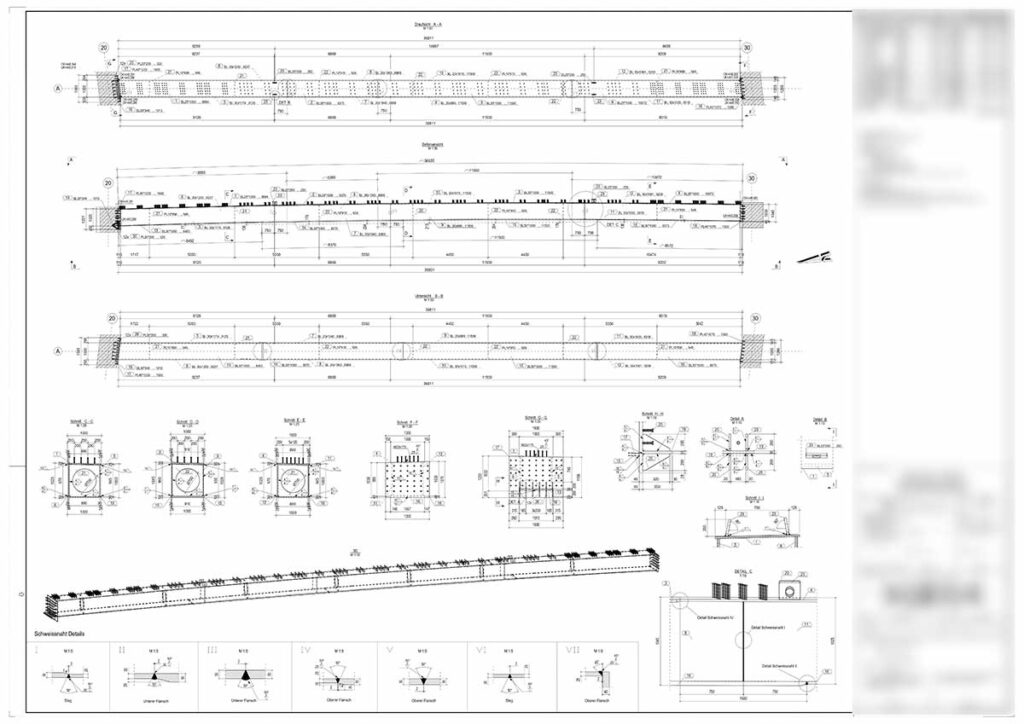
Shop drawings (also called detail drawings or fabrication drawings) are used by the steel fabricator in the workshop. Each drawing covers a single piece or assembly — a column, a beam, a staircase stringer — and includes everything the fabricator needs to cut, drill, and weld it correctly:
- Exact dimensions and lengths: to the millimetre
- Hole sizes and positions: for bolted connections
- Weld sizes and symbols: showing where and how to weld
- Material specification: steel grade, section size, finish
- Member mark: a unique code that links the piece to the erection drawing
A shop drawing is never used on site. By the time steel reaches the erection crew, the shop drawing has already served its purpose.
Erection Drawings
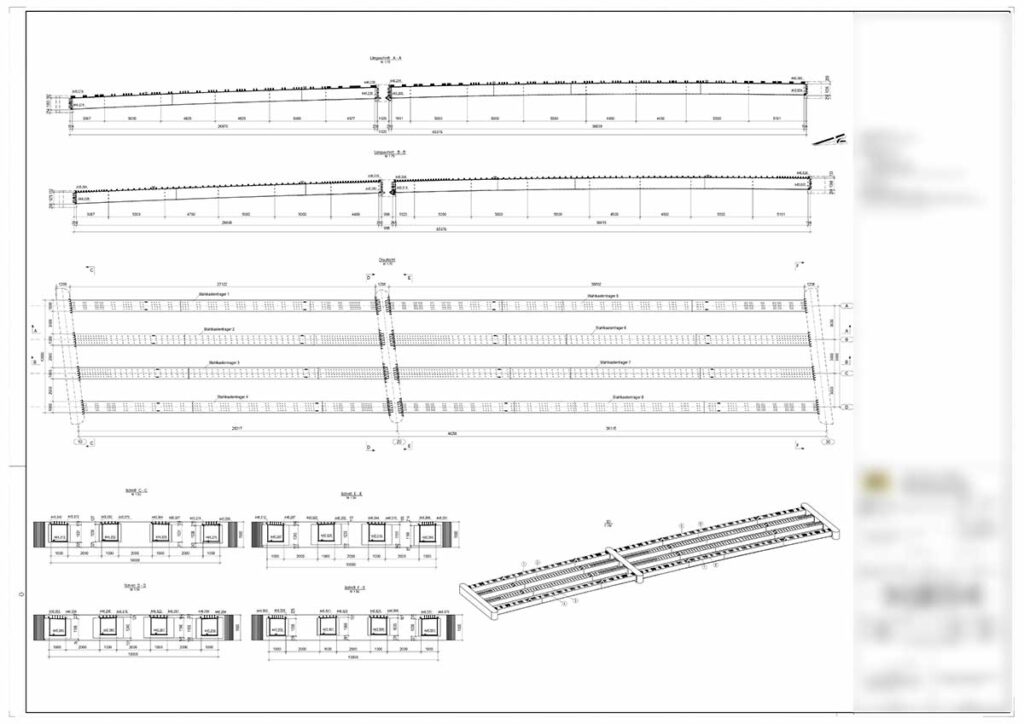
Erection drawings (also called GA drawings — General Arrangement) are used by the erection crew on site. They show the big picture: where each member goes, how it connects to the others, and in what sequence the frame should be assembled. They contain:
- Grid lines and setting-out dimensions: so the erector can position columns correctly
- Member marks: matching those on the shop drawings so the crew can identify each piece
- Connection details: bolt patterns, orientation of members
- Levels and elevations: beam soffit heights, floor levels
Erection drawings contain very little fabrication detail — by the time they are used, the steel has already been made. Their job is purely to tell the erector where everything goes.
A complete detailing package contains both: shop drawings for every individual piece, and erection drawings for the full structure. The detailer is responsible for making sure these two sets of drawings are fully coordinated — the member marks must match, the connections must align, and nothing can clash.
Steel Detailer Skills And Tools Used
Steel detailing is a highly specialized field that requires a specific set of skills and knowledge. Some of the key skills and knowledge needed for a successful career as a steel detailer include:
- Proficiency in CAD Software: Steel detailers must be proficient in using computer-aided design (CAD) software, which is used to create detailed 3D models and fabrication drawings.
- Ability to Read Construction Plans: Steel detailers must be able to read and interpret construction plans, including architectural and engineering drawings, and use this information to create accurate models and drawings.
- Attention to Detail: Steel detailing requires a high level of attention to detail, as even minor errors can have significant consequences for the safety and functionality of a steel structure, as well as massive loss of money and time. They must be really committed to carrying out their obligations and be able to do a perfect job at the fastest rate.
- Communication Skills: Steel detailers must be able to communicate effectively with other professionals involved in the project, including architects, engineers, and contractors. They must be able to listen to feedback and incorporate it into their work. Must be able to write an RFI (Request For Information) in a clear and concise manner to gather information to move the project forward.
- Knowledge of Building Codes and Regulations: Steel detailers must understand building codes and regulations, industry standards, and best practices. They must ensure that all of their work complies with these standards and regulations to ensure the safety and functionality of the final product.
The software a steel detailer uses depends on the market they work in, the type of projects, and what their clients or employer require. Here are the main tools used in the industry today:
| Software | Type | Best known for |
| Tekla Structures | Full 3D BIM modelling | The industry standard for complex structural steel. Outputs shop drawings, NC files, and BOMs directly from the model. |
| AutoCAD / AutoCAD Structural Detailing | 2D drafting | Still widely used for 2D shop drawings and erection drawings, especially in smaller fabrication shops. |
| Advance Steel (Autodesk) | 3D modelling | Popular in the US and Europe. Integrates with AutoCAD and Revit workflows. |
| SDS/2 | 3D modelling + connection design | Very popular in North America. Strong automated connection design tools built in. |
| Revit (Structure) | BIM coordination | Used more for coordination with architects and MEP than for fabrication-level detailing. |
| ProSteel | 3D modelling | Used mainly in Europe, particularly on industrial and heavy structural projects. |
Most professional detailers today work primarily in Tekla Structures. It allows the detailer to build a complete 3D model of the structure and then automatically generate shop drawings, erection drawings, NC (numerical control) files for CNC cutting machines, and bills of materials — all from the same model. This dramatically reduces the risk of errors that occurred when drawings were produced manually or in 2D.
That said, knowing one piece of software is rarely enough. Different clients have different preferences, and a detailer who can work across multiple platforms — or at least read and coordinate with outputs from other tools — is far more employable.
Why is steel detailing challenging to do?
The main issue facing this industry is a lack of information. Exact and precise requirements are the thing that makes it difficult — the amount of information that we handle.
There are numerous types of jobs you can work on, and they all require different skills. You can work on industrial projects as well as commercial ones. That means you need to model gratings, stairs, ladders, canopies, light gauge steel, galvanized steel, etc.
There is so much information to remember. The codes have become so much more complex. You also need to have a brief understanding of the other phases of the building, like electrical, HVAC, etc. For seismic regions, there are different requirements for the connections.
Another thing is that every client has different requirements, and you must adjust your software to meet those requirements. For example, they want drawings done their way. Therefore, customization is also your part, and you must have some software experience.
You may hear that now with all the modern software, the work is so much easier. But, Can’t agree with that. Yes, calculations are faster than paper and pencil, but the expected quantity of output has undoubtedly adjusted to that. Also, the increased amount of output means an increased quantity of liability carried.
Steel Detailer Career Path
One of the most common questions people ask about steel detailing is: where does it lead? Here is a typical career progression in the industry:
| Level | Role | What it involves |
| Entry level | Junior Detailer / Drafter | Learning software, modelling simple members, checking drawings under supervision. |
| 2–5 years | Steel Detailer | Handling full projects independently — modelling, drawing production, RFIs, client communication. |
| 5–10 years | Senior Detailer / Checker | Reviewing and approving other detailers’ work, managing complex projects, mentoring juniors. |
| 10+ years | Lead Detailer / Project Manager | Managing multiple projects and teams, client relationships, business development. |
| Advanced | BIM Manager / Own Business | Running BIM workflows for large firms, or starting an independent detailing business. |
It is worth noting that steel detailing is one of the few technical construction careers where you do not need a university degree to reach a senior level. What matters most is your ability to produce accurate, coordinated drawings quickly — and that comes from experience, not academic qualifications.
Many detailers also move into related fields over time. Connection design, structural BIM management, and project engineering are all natural progressions for an experienced steel detailer who wants to take on more technical or managerial responsibility.
How to Become a Steel Detailer
There is no single fixed route into steel detailing, which is part of what makes it accessible. Here are the most common paths people take:
Vocational / Technical Training
A drafting or CAD technician qualification from a vocational school or community college is the most direct route. These programs teach the fundamentals of technical drawing, reading engineering documents, and using CAD software. From there, most people enter the industry as junior detailers and learn the steel-specific knowledge on the job.
Apprenticeship or On-the-Job Training
Many steel detailers learned the trade entirely through apprenticeship — joining a fabrication company or detailing firm at a junior level and being trained by senior detailers. This route takes longer to reach full competency but produces extremely practical, industry-ready knowledge. It is still one of the most common entry paths, particularly in the UK and Australia.
Engineering or Architecture Background
Some detailers come from a structural engineering or architectural background and move into detailing because they enjoy the practical, production side of the work more than analysis or design. A structural engineering degree is not necessary, but having one gives you a significant advantage in understanding the ‘why’ behind what you are drawing.
Software Certifications
Formal software certification — particularly Tekla Structures certification — is increasingly valued by employers. Trimble (who own Tekla) offer official training and certification programmes, and holding a recognised certification can meaningfully improve your employability and starting salary, especially if you are changing careers later in life.
Regardless of the route, the key is to start getting hands-on with the software as early as possible. Tekla Structures offers student licences, and there are training resources available online. Building a small portfolio of practice models — even simple portal frame structures — demonstrates initiative and practical ability to potential employers.
Steel Detailer Salary
Steel detailer salaries vary significantly depending on experience level, location, the type of projects you work on, and whether you are employed or freelance. Here is a general overview based on data from US salary sources as of 2025–2026:
| Experience Level | Typical Annual Salary (US) | Hourly Rate (approx.) |
| Entry level (0–2 years) | $35,000 – $50,000 | $17 – $24/hr |
| Mid-career (2–7 years) | $50,000 – $70,000 | $24 – $34/hr |
| Senior (7+ years) | $70,000 – $90,000+ | $34 – $45/hr+ |
| Freelance / Contract | Varies widely | $50 – $100/hr |
Freelance detailers — particularly those working remotely on projects in higher-cost markets — can earn considerably more than salaried employees. The rise of remote work has also opened up the ability to work for clients in the US, UK, or Australia while living in a lower cost-of-living country, which many detailers now do.
In the UK and Australia, salaries follow a broadly similar pattern relative to local market rates. UK detailers typically earn between £28,000 and £55,000 per year depending on experience, while Australian detailers can expect AUD $60,000 to $90,000+.
The factors that most reliably push salaries upward are: software proficiency (especially Tekla), experience on complex project types (high-rise, bridges, industrial), the ability to work across multiple disciplines (miscellaneous steel, stairs, handrails), and the ability to check and manage other detailers’ work.
Frequently Asked Questions
Yes — steel detailing is one of the most remote-friendly roles in the construction industry. The entire job is done on a computer using 3D modelling and drafting software. Many detailers work as freelancers or for offshore detailing firms, delivering drawings remotely to fabricators in the US, UK, or Australia. All that is typically required is a good computer, the right software licences, and a reliable internet connection for file sharing and communication.
No. Steel detailing is one of the few technical construction careers where a degree is not required to reach a senior level. Most detailers enter through vocational training programs, apprenticeships, or by learning on the job at a fabrication company. What employers care about most is software competency, accuracy, and the ability to produce drawings quickly. That said, a background in structural engineering or architecture is a useful advantage.
Most detailers reach a level of solid independent competency after around 2–3 years of full-time work on real projects. However, genuine expertise — where you can handle complex connections, unusual project types, and check other people’s work confidently — typically takes 5+ years. The learning curve is steeper at the start (learning software and reading structural drawings) and then gradually levels off as pattern recognition and experience build up.
No — they are distinct roles. A structural engineer designs the structure: they calculate loads, select member sizes, and take legal responsibility for the structural integrity of the building. A steel detailer translates those engineer’s documents into production-ready fabrication drawings. The detailer does not design the structure; they detail it. However, an experienced detailer develops a deep practical understanding of how structures go together that engineers often do not have.
Shop drawings (also called detail or fabrication drawings) are used in the fabrication workshop to manufacture each individual steel piece. They show exact dimensions, hole sizes, weld details, and material specs for a single member or assembly. Erection drawings (GA drawings) are used on site to show the erection crew where each piece goes, how members connect, and in what sequence the frame should be assembled. Both sets of drawings must be fully coordinated by the detailer.
The most widely used software in professional steel detailing is Tekla Structures, which is considered the industry standard for complex structural projects. Other common tools include Advance Steel (Autodesk), SDS/2 (popular in North America), AutoCAD for 2D work, and Revit for BIM coordination. Most professional detailers are proficient in at least one 3D modelling platform and one 2D CAD tool.
Closing Thoughts
Steel detailing is essential for achieving accurate fabrication and assembly, minimizing waste, reducing costs, and ensuring compliance with safety codes and regulations. It also allows for design flexibility and the ability to achieve complex designs.
If you are interested in pursuing a career in steel detailing, there are many educational programs available to help you gain the knowledge and skills necessary for a successful career as a steel detailer. With the proper education and training, you can be an integral part of the construction industry and help bring complex steel structures to life.


